
Published on
March 5, 2026
~
5
min


You don’t launch a commerce platform in manufacturing to “experiment.” You launch it because quoting is messy, partners are frustrated, and ops is tired of duct-taping systems together.
So why do so many manufacturing teams quietly start planning a rebuild a few months after go-live?
Something doesn’t line up between how these platforms are designed and how manufacturing actually operates. And it shows up fast! In approvals that don’t fit real workflows, partner experiences that feel off, and systems that were never meant to handle industrial-scale complexity…
So grab a seat, and let’s discuss the commerce architecture behind manufacturing and why it needs something different from your usual!
Manufacturing digital commerce rarely breaks because of “bad execution.” It breaks because the day-to-day reality of manufacturing is structurally complex, and most commerce platforms are not built to carry that weight.
Because, as most know, manufacturers don’t sell static products. They sell configurable systems, contract-based pricing, region-specific assortments, service bundles, spare parts, and long-tail SKUs that behave differently across customers and markets.
A single “order” can involve approvals, compliance checks, margin controls, distributor rules, inventory visibility across plants, and delivery promises tied to production capacity.
Digital commerce, in this world, is not a checkout layer; it’s an operational surface area.
That creates real, non-negotiable needs for manufacturing commerce:
The rebuild usually starts when teams realise the platform can’t evolve with these realities.
At first, teams try to patch the gaps by adding custom rules and manual workarounds, but soon the system can’t keep up. Sales teams start bypassing the platform, partners revert to email and spreadsheets, and operations build parallel processes just to make the commerce layer reflect how the business actually runs.
Over time, the stack stops being a growth engine and starts becoming friction.
That’s when the question quietly shifts from “How do we optimise this?” to “How do we replace this without disrupting the business again?”
Manufacturing isn’t doing this out of laziness or taking the easy way out. Replacing a system without disrupting the business is hard. Teams rebuild because the original commerce architecture was never built for manufacturing realities.
At the heart of the challenge is a simple fact!
Commerce platforms were designed for retail, not industrial-scale manufacturing.
Commerce platforms were designed for quick transactions, simple catalogues, and straightforward customer journeys, the kind of environment where a single product can be sold to many customers with minimal customisation.
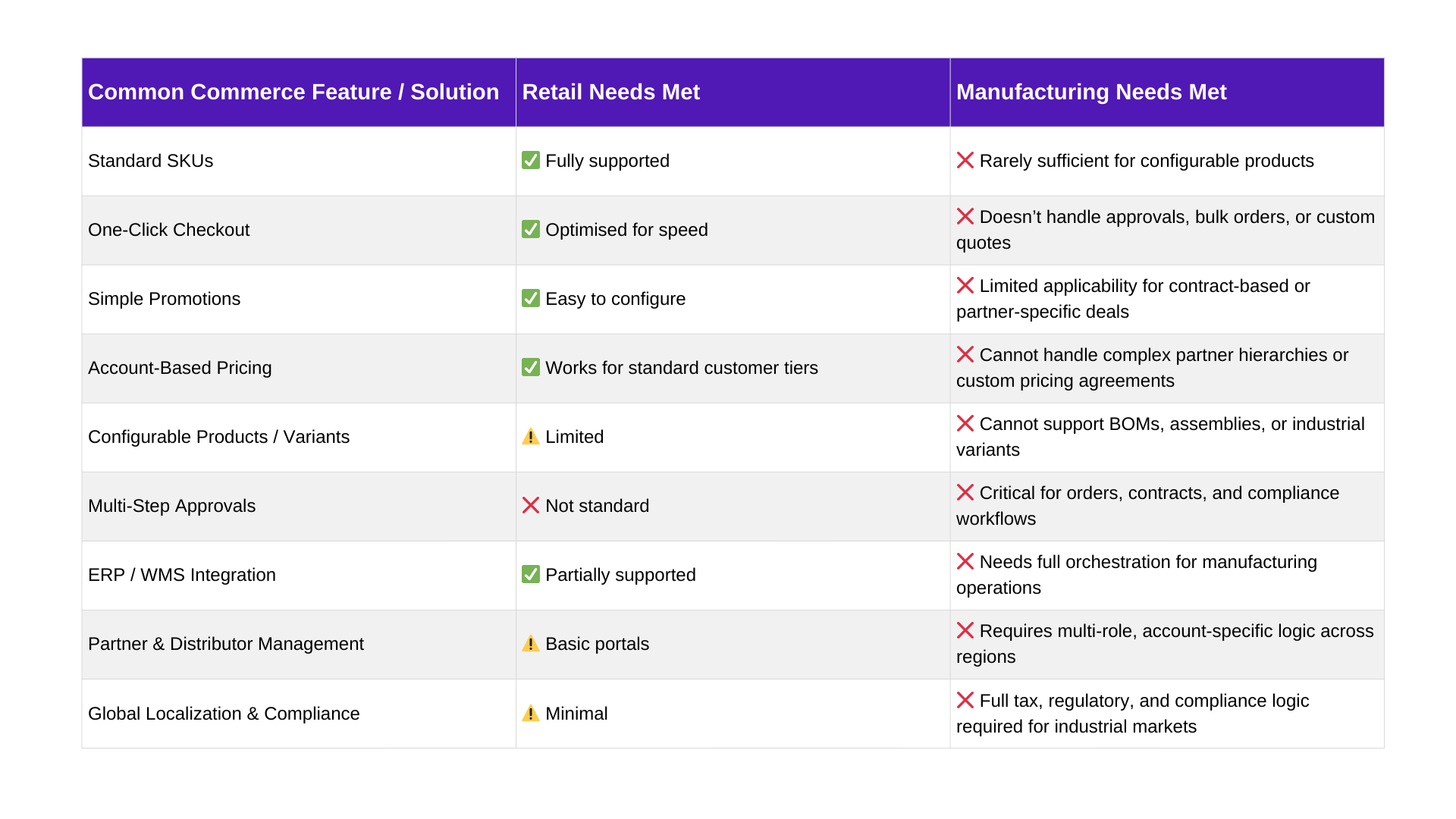
Features like one-click checkouts, standard SKUs, and easy promotions make sense for apparel, electronics, or consumer goods, but they rarely cover the complexities of industrial-scale operations.
Manufacturing requires commerce to do much more: handle configurable products, account-specific pricing, multi-step approvals, partner hierarchies, and real-time inventory tied to production capacity.
Systems need to orchestrate orders across ERP, WMS, CRM, and even compliance layers, all while scaling to global markets. The mismatch is that what works for retail meets its limits in manufacturing, and teams quickly find themselves patching, rebuilding, or bypassing the platform entirely.
Below is a breakdown of the original retail commerce structure, showing which needs it meets, and where manufacturing requirements go unmet:
In manufacturing commerce, “handle it after launch” is a strategic burden that shows up everywhere you look.
Manufacturing teams attempting to patch gaps post‑go‑live battle deep operational drag, integration breakdowns, and compounding technical debt that erodes competitiveness.
Recent industry data highlights just how costly these legacy and misaligned systems can be.
Research into digital transformation in industrial settings reveals that 70 % of manufacturing transformation initiatives fail to reach full scale, often stalling precisely because systems weren’t designed for their operational realities in the first place.
Legacy and integration issues are more than theoretical problems; they carry real financial implications.
One study found that manufacturers managing an average of 17 different enterprise systems struggle with data integration in 72 % of cases, spending 31 % of transformation budgets on just data integration and grappling with data accuracy problems that can cost millions in operational inefficiencies.
When systems don’t reflect how manufacturing works, teams resort to workarounds that quietly drain resources.
Manual processes and parallel systems take hold because the commerce layer fails to integrate cleanly with production scheduling, inventory controls, pricing engines, or quoting workflows, a pattern seen across more than half of industrial digital transformations.
Disconnected systems show their true cost in operations as well.
Some European manufacturers discovered that fragmentation (like separate ERP, transport, and warehouse systems) results in €2.1 million in annual costs simply due to manual data re‑entry and siloed documentation processes.
These costs are not limited to finance teams. Integration complexity frequently causes projects to be delayed or reworkedi nearly 47 % of integration efforts result in post‑implementation rework, adding weeks or months of remediation and driving up total spend.
What’s initially treated as a “fix later” instead becomes a long‑term tax on operational velocity!
When systems are patched rather than designed for manufacturing realities, teams spend less time innovating and more time firefighting, and every hour spent on manual work, reconciliation, or workaround scripting is an hour not spent on growth.
Manufacturing teams repeatedly rebuild their commerce stacks because traditional, retail‑focused platforms cannot handle the complexity of industrial operations.
The operational demands of manufacturing quickly outgrow systems built for simpler transactions. The solution is a commerce platform designed around manufacturing realities.
Flexible, composable, and capable of orchestrating complex workflows while integrating seamlessly with ERP, WMS, CRM, and other core systems.
Lidia Commerce delivers precisely this, providing manufacturers with a single, scalable platform that supports industrial-scale complexity, accelerates partner onboarding, and reduces the need for constant patching and rebuilds.
With Lidia, manufacturers can finally focus on growth, innovation, and delivering consistent experiences across all customers and channels.
Explore now!
Next Generation of Commerce | Lidia Commerce


