
Published on
October 9, 2026
~
4
min


Enterprise digital commerce is rarely built by a single technology provider.
Behind every successful digital commerce initiative lies a combination of technologies, industry expertise, integration capabilities and implementation experience. From connecting enterprise systems to launching new sales channels, businesses need more than a capable platform. They need the right expertise to bring different components together.
As commerce requirements become more complex, collaboration between technology providers, implementation specialists and commercial partners becomes increasingly important.
At Lidia Commerce, this understanding shapes the Lidia Commerce Partner Ecosystem — an approach built around combining complementary expertise to address real business challenges, deliver connected commerce solutions and create new opportunities for customers and partners.
The idea is straightforward: bringing the right capabilities together can create greater value than approaching every commerce challenge independently.
Modern enterprises operate across increasingly interconnected environments.
A manufacturer developing a B2B sales channel may need to connect its ERP system with product information management and digital ordering processes. A retailer expanding into a new market may require local payment and logistics solutions. Another organisation may want to introduce specialised AI capabilities into its existing product management workflows.
Each business faces different requirements, and not every capability needs to be developed by the same technology provider.
What matters is how effectively these solutions work together.
Lidia Commerce provides a modular digital commerce platform supporting business models such as B2B, B2C and marketplace commerce, alongside product information management and other commerce capabilities.
Through its API-first architecture, Lidia enables businesses to connect digital commerce operations with existing enterprise systems and complementary technologies.
The Lidia Commerce Partner Ecosystem builds on this foundation by bringing in the specialised knowledge, technology and delivery capabilities needed to address different customer requirements.
Rather than positioning technology as a standalone solution, the ecosystem connects platform capabilities with the expertise required to implement, extend and support them.
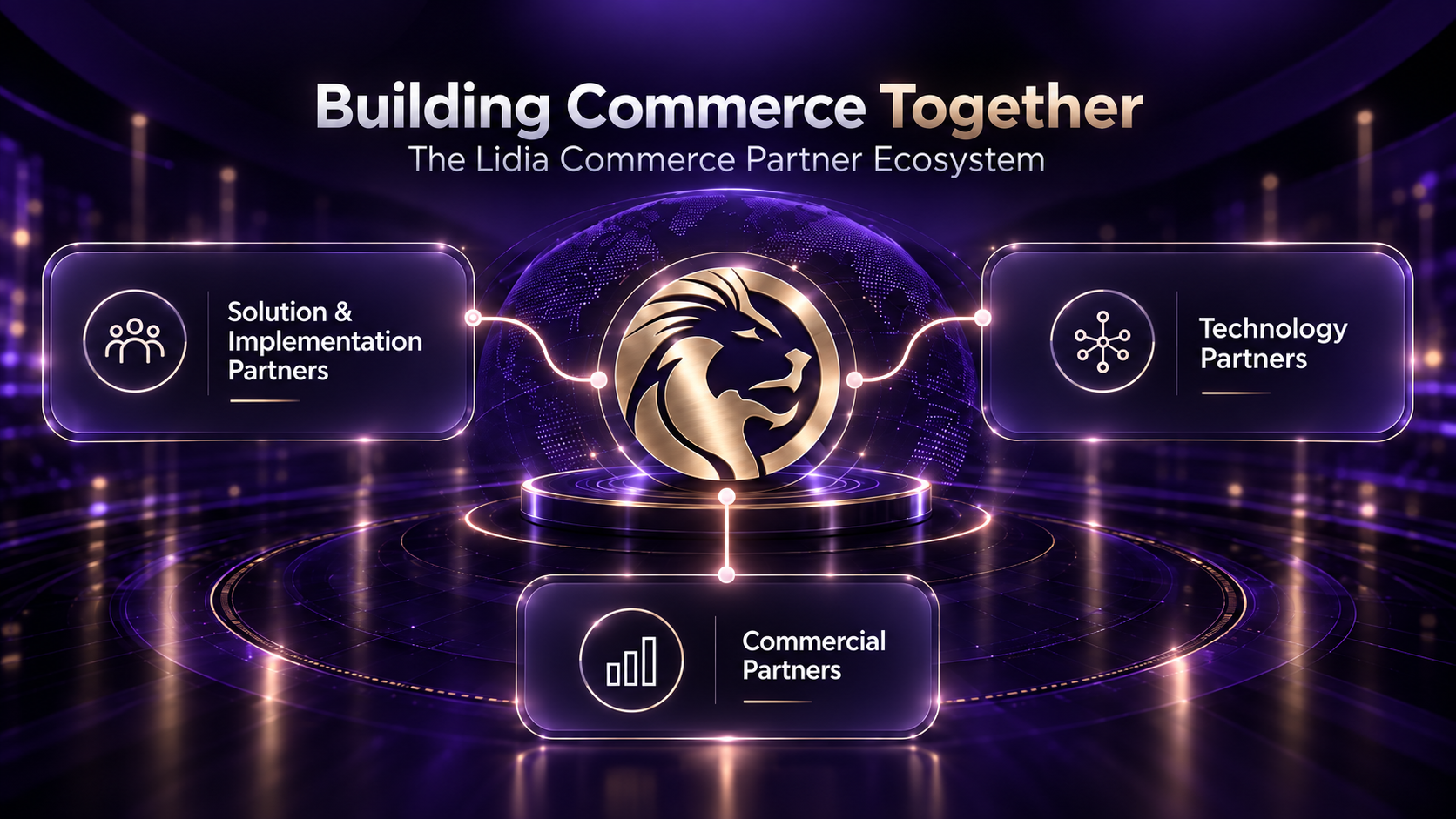
The Lidia Commerce Partner Ecosystem brings together organisations with different but complementary areas of expertise.
These collaborations generally fall into three main groups.
Solution and implementation partners help businesses turn their commerce requirements into working solutions.
Their expertise can cover business analysis, frontend and backend development, system integration, quality assurance, deployment, project management and ongoing technical support.
By working with Lidia Commerce, implementation partners can deliver projects built on Lidia's product family, including B2B, B2C, marketplace and PIM solutions.
This approach allows partners to combine Lidia's commerce capabilities with their own development, delivery and industry experience, creating solutions tailored to specific customer needs.
Technology partners contribute specialised capabilities that complement the Lidia Commerce platform.
These may include artificial intelligence, product recommendations, search technologies, catalogue enrichment, mobile experiences, customer engagement, payment solutions and logistics services.
Integration and connector providers also play an important role by enabling Lidia-powered commerce environments to communicate with ERP platforms and other enterprise systems.
For technology providers, collaborating with Lidia creates opportunities to bring their solutions into practical enterprise commerce scenarios and explore new ways to reach customers through complementary offerings.
Commercial partners focus on developing business opportunities through shared market knowledge, customer relationships and sales activities.
This group may include consulting companies, agencies and organisations with established customer networks across particular industries or markets.
Collaboration can involve identifying suitable customer opportunities, introducing Lidia Commerce solutions to existing client networks or developing joint commercial initiatives.
The relationship can also work in both directions: partners may introduce Lidia to relevant customer opportunities, while Lidia may identify situations where a partner's expertise or services would add value.
These categories are not mutually exclusive. Depending on their capabilities, organisations may contribute to more than one area of the ecosystem.
A successful partner ecosystem should create value for everyone involved.
For enterprise customers, the primary advantage is the ability to bring different technologies and areas of expertise together around their business requirements.
Instead of evaluating a commerce platform, integration capabilities and implementation services as completely separate elements, organisations can benefit from a more coordinated approach to delivering their digital commerce projects.
For implementation partners, Lidia Commerce provides a technology foundation on which they can develop solutions, deliver integrations, build customer experiences and offer ongoing support services.
For technology providers, the ecosystem presents opportunities to connect specialised applications and services with relevant commerce use cases.
For commercial partners, collaboration creates opportunities to expand the solutions they can introduce to their customers while developing new business relationships and joint opportunities.
The goal is not simply to increase the number of companies within a partner network.
It is to establish relationships that bring complementary capabilities together and create sustainable value through real customer projects.
At the centre of Lidia Commerce's partnership approach is a simple question:
What customer problem can we solve together?
This question guides how potential collaborations are evaluated.
A prospective partner's technical expertise, enterprise commerce experience, target industries, market access and delivery capabilities are considered alongside the value their solutions or services could contribute to Lidia customers.
For technology partners, this includes understanding integration requirements, APIs, data flows, security considerations and operational compatibility.
For implementation partners, the focus also extends to software development capabilities, project delivery, quality assurance, technical operations and ongoing support.
Commercial fit and the long-term sustainability of the relationship are equally important.
Depending on the proposed collaboration, the process may involve defining a shared use case, clarifying technical and commercial responsibilities, and evaluating compatibility through a sample project, sandbox exercise or limited pilot.
The objective is to move beyond an initial partnership discussion towards a clearly defined opportunity that both parties can support.
The value of a connected partner ecosystem becomes clearer through practical business scenarios.
Consider a manufacturer looking to modernise its B2B ordering operations.
Lidia PIM and Lidia B2B could provide the product information and digital commerce capabilities, while an integration partner connects the environment with the manufacturer's ERP system. An implementation partner could contribute the development, testing and deployment expertise needed to deliver the project.
In another scenario, a retailer entering a new market might combine Lidia's commerce capabilities with local payment, logistics and support providers to address region-specific operational requirements.
A business managing a large product catalogue could explore specialised AI solutions for product descriptions or visual enrichment alongside its existing product information management processes.
These examples illustrate how different areas of expertise can work together to address enterprise commerce requirements.
They also highlight the potential to develop repeatable integrations and implementation approaches that can be adapted to similar customer needs in future projects.
The technologies shaping enterprise commerce continue to evolve.
Artificial intelligence, specialised applications and new integration requirements are creating opportunities for businesses to extend their existing digital commerce environments.
For Lidia Commerce, developing its partner ecosystem is part of preparing for these changing requirements.
One area of ongoing work is the Lidia App & AI Agent Store initiative, which explores how specialised technology providers could make complementary applications and AI-powered capabilities available within Lidia-powered commerce environments.
The broader partner ecosystem also supports collaboration around enterprise integrations, implementation expertise and market-specific requirements.
As these initiatives develop, the focus remains on identifying meaningful use cases, building reusable capabilities and bringing together solutions that complement the Lidia Commerce platform.
Enterprise commerce will continue to require different technologies, specialised expertise and new approaches to solving business challenges.
No single organisation needs to address every requirement independently.
Through the Lidia Commerce Partner Ecosystem, Lidia aims to build long-term collaborations that bring together technology, implementation and commercial expertise around shared opportunities.
For technology providers, implementation specialists, agencies and consulting organisations, this creates opportunities to explore how their capabilities can complement Lidia's digital commerce platform.
The future of commerce is connected. Building it requires collaboration.
Organisations interested in exploring potential partnerships with Lidia Commerce are invited to connect with the team and discover what they could build together.
Lidia Commerce is a modular, API-first enterprise digital commerce platform supporting B2B, B2C and marketplace business models, alongside product information management and other commerce capabilities.
Its flexible architecture enables organisations to develop and modernise digital commerce operations while integrating with existing enterprise systems and complementary technologies.


