
Published on
May 6, 2026
~
5
min
-20260430-131632.png)


In digital commerce, the distance between intent and action has collapsed.
Consumers no longer move through structured funnels or wait for campaigns to catch up. They act in bursts, quick, intent-driven decisions that happen in seconds.
‘Research shows that many purchase decisions are now made in under 10 seconds, compressing the window brands have to respond.’
At the same time, behaviour has become increasingly fragmented.
‘Around 85% of consumers start a journey on one device and complete it on another, signalling that decision-making is no longer linear but distributed across moments, contexts, and channels.’
These shifts are redefining how value is captured in digital commerce.
Growth is no longer driven by who plans better campaigns, but by who can recognise and respond to intent as it happens. What used to be touchpoints are now high-intent, short-lived opportunities, micro-moments where decisions are shaped instantly, and expectations for speed and relevance are absolute.
This is where digital commerce is being rewritten: not in journeys, but in moments.
Micro-moments in digital commerce are intent-driven, real-time customer actions where a decision is about to happen, or already happening.
They don’t follow a predefined journey or wait for a campaign to catch up. They appear suddenly, shaped by context, timing, and need.
What’s changed is not just speed, but structure.
The “journey” still exists, but it’s fragmented into dozens of high-intent moments that don’t necessarily connect linearly.
This shift is visible across everyday commerce scenarios:
Each of these moments is small in duration but high in impact. They are shaped by signals: clicks, scroll depth, dwell time, repeat visits, device switching, and inventory checks.
The volume of these signals has grown rapidly, and with it, the expectation that brands can interpret and act on them instantly.
This is why micro-moments are reshaping digital commerce.
Decision windows are shrinking. Customers expect immediate responses, not delayed follow-ups. Waiting even a few minutes can mean losing the moment entirely. At the same time, the number of observable signals has increased, giving brands more context but also raising the complexity of acting on it.
Digital commerce is no longer about guiding customers through a journey. It’s about recognising when intent surfaces and responding while it’s still there.
Micro-moments don’t appear randomly. They are built on signals, small, observable actions that indicate intent. The challenge isn’t collecting data; it’s recognising which signals matter while they’re happening.
In digital commerce, three signal types shape these moments.
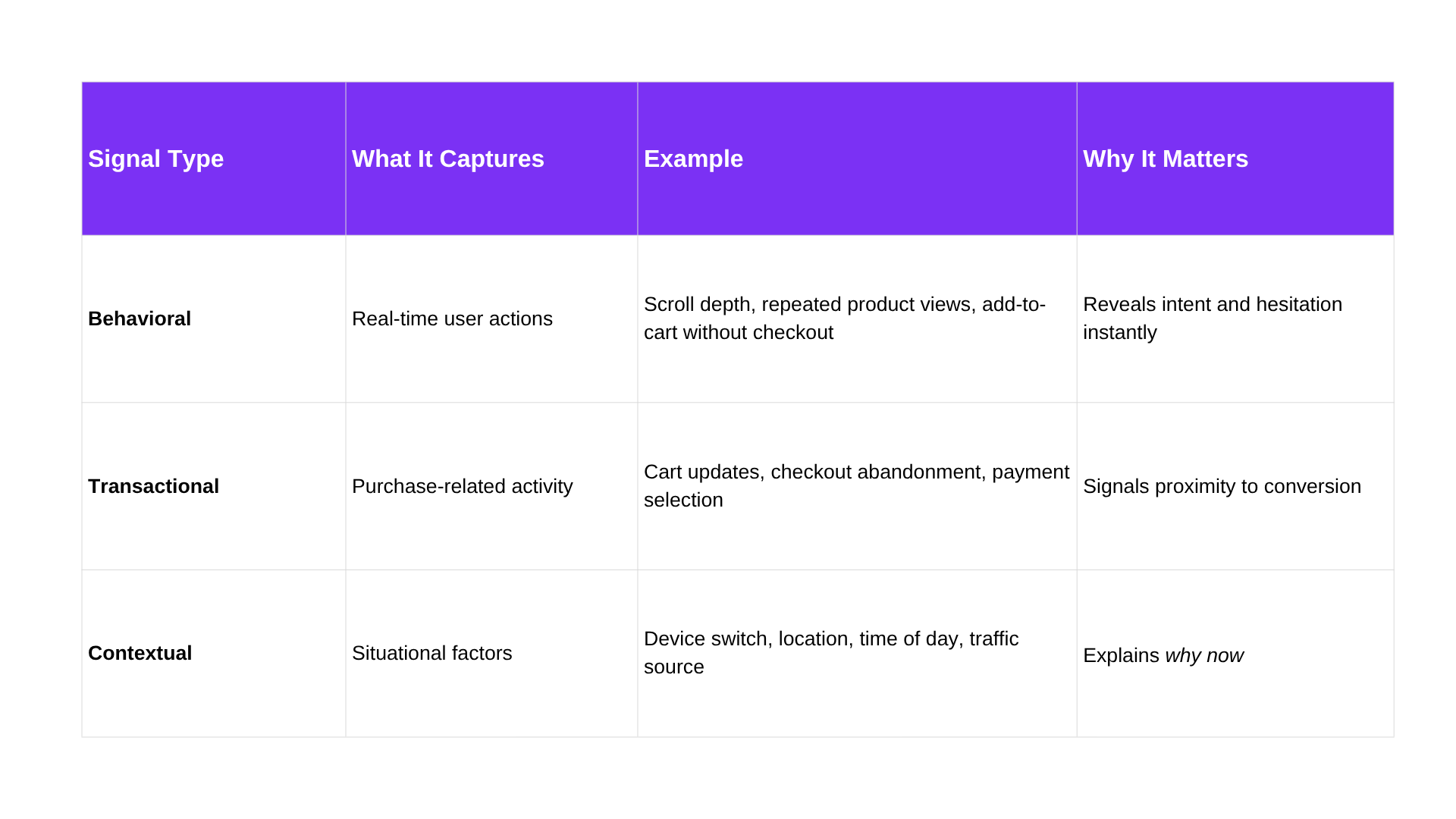
Some of the highest-impact signals are easy to overlook!
-20260506-085957.png)
Delayed insights create missed opportunities. Real-time data enables action within the moment.
This is where first-party data becomes critical: not as storage, but as a trigger layer that turns signals into immediate decisions.
Recognising micro-moments is one thing. Acting on them consistently is another.
Even teams that are highly capable of spotting intent signals struggle to respond in time when the underlying architecture can’t support real-time execution.
Because micro-moments don’t wait for systems to catch up.
A digital commerce architecture aligned with micro-moments gives you three critical capabilities:
Every action (click, scroll, cart update) can be captured and interpreted as it happens.
Systems can process signals instantly and trigger the right response without manual intervention.
The same logic applies across web, mobile, store, and partner channels, ensuring continuity in every interaction.
These capabilities don’t come from layering more tools on top. They come from how the system is designed.
To operate at this level, leading digital commerce architectures rely on:
This is what makes micro-moment execution possible at scale.
Without it, even the best strategies break down.
→ Signals arrive too late to act on. → Campaign updates depend on release cycles. → Personalisation remains limited to predefined segments. → Channels operate with inconsistent data and logic.
The result isn’t just slower execution, it’s lost intent.
Because in real-time digital commerce, the gap between recognising a micro-moment and acting on it is where most value disappears.
Micro-moments don’t wait.
In digital commerce, intent forms and fades in seconds. The real advantage comes from acting within that window, not after it. Seeing the signal isn’t enough; turning it into action, instantly and across channels, is what drives conversion.
This is where the gap appears. Between recognising intent and responding to it. And that gap is almost always architectural.
If your systems can’t process signals, trigger decisions, and execute in real time, micro-moments stay invisible where it matters most: impact.
Lidia Commerce helps you close that gap. Turn signals into actions, and moments into measurable growth.


