
Published on
August 14, 2026
~
5
min
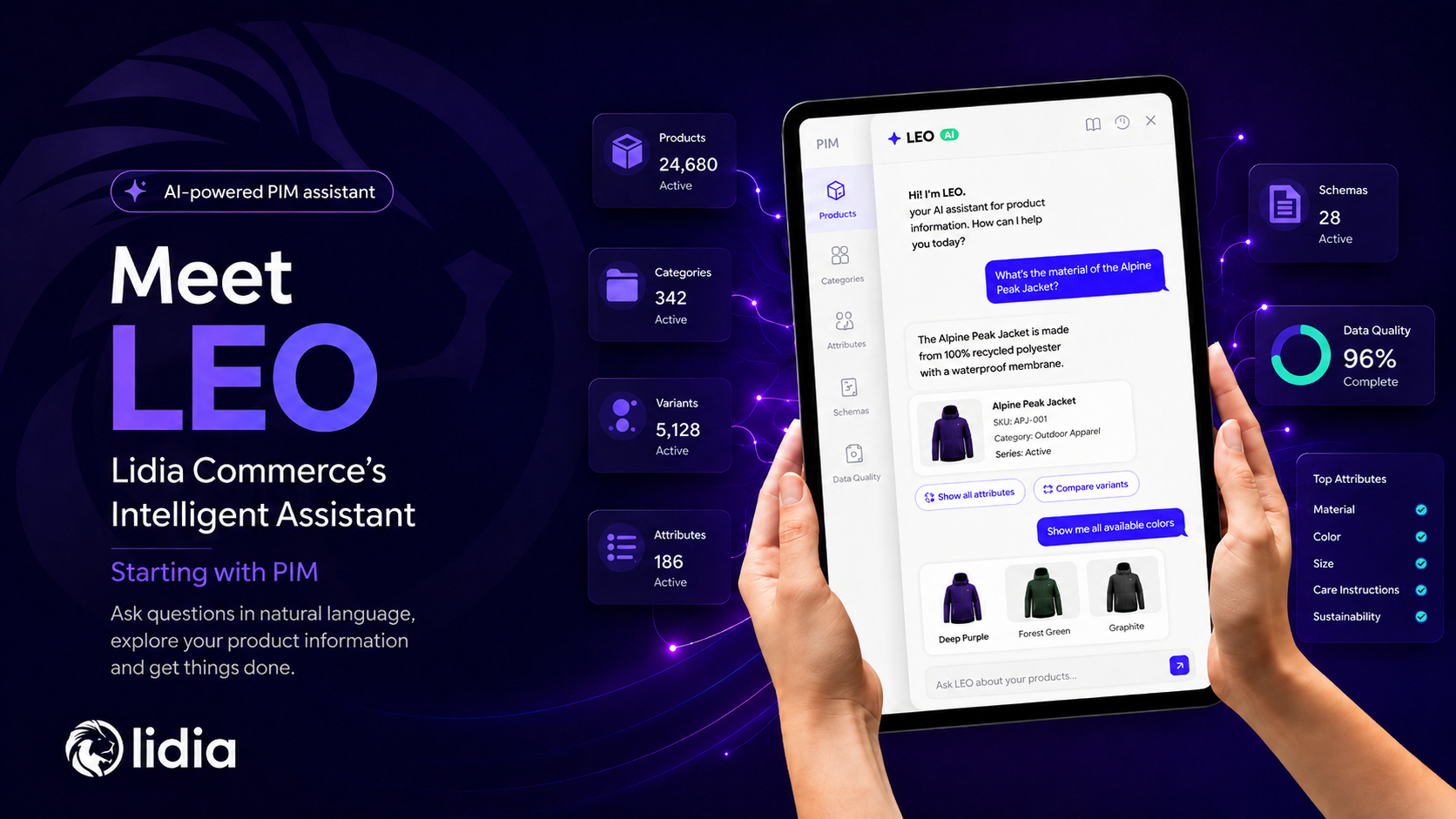


Lidia Commerce is introducing LEO, a new intelligent assistant designed to create a more natural way for users to interact with complex commerce systems and the information behind them.
Rather than requiring every question to begin with the right screen, filter or technical field, LEO allows users to start with what they actually want to know.
LEO is making its first appearance in Lidia PIM.
Product information management provides a natural starting point. Enterprise catalogues contain thousands of interconnected records, from products and variants to categories, brands, attributes, schemas, tags and publication states. Understanding those relationships can require considerable platform knowledge and frequent navigation between different areas of a PIM.
With LEO, Lidia Commerce is introducing a different interaction model: one where users can ask questions in natural language and receive answers connected to the context and data available within the platform.
Lidia PIM is the first environment where that experience is being put into practice.
Managing product information at enterprise scale is rarely just about storing data.
As catalogues grow, so does the network of information surrounding every product. A single product can belong to a category hierarchy, inherit a Data Schema, contain several variants, depend on specific options and properties, carry different tags and move through multiple stages before it is ready for publication.
For experienced PIM teams, these relationships become part of everyday work. For newer users, they can create a considerable learning curve. Even experienced teams can spend time moving between screens, adjusting filters and tracing connections between different records.
This makes PIM a particularly relevant first use case for LEO.
By bringing an intelligent conversational layer into Lidia PIM, LEO creates another way to access product information and understand how the system works — without requiring users to translate every business question into a sequence of platform actions first.
At the centre of the LEO experience is a simple idea: users should be able to begin with a question.
A user might want to understand a particular product, find the variants connected to it, explore a category or brand, or learn what a specific PIM concept means.
Instead of first identifying the correct menu and constructing the right filters, users can ask questions such as:
LEO can identify the type of information being requested and connect the question to the relevant PIM information.
Importantly, not every question needs to be about an organisation’s catalogue.
LEO also includes PIM-specific knowledge that helps users understand concepts and workflows across categories, Data Schemas, Data Pools, products, variants, brands, options, properties, custom lists and tags.
This means its first implementation serves two complementary purposes: helping users work with product information and helping them understand the environment in which that information is managed.
Product-data questions are not always expressed using the exact terminology stored in a catalogue.
A user might describe a product using everyday language, while another request might specify a precise brand, category, code or publication state.
LEO is designed to work with both types of interaction.
Within its PIM implementation, semantic search can help interpret the meaning behind a request, while structured catalogue queries can preserve precision when the question contains specific product-data conditions.
For the user, the important part is not the underlying query structure.
The objective is to make it possible to express a request naturally while still connecting the response to actual information held within the PIM.
Retrieved product data can then be used as context for LEO’s response, helping answers remain connected to information available within the application rather than relying only on general language-model knowledge.
A useful enterprise assistant needs to understand more than the sentence entered into a chat box.
It also needs to understand where the user is working.
LEO has therefore been designed with application and entity context in mind.
When a user interacts with LEO while working within a particular part of Lidia PIM or viewing a specific product record, that context can contribute to how the request is interpreted.
Conversation history can provide additional continuity for follow-up questions.
The result is an interaction model in which users do not necessarily need to repeat the same context with every request. The application itself can become part of the conversation.
This is particularly relevant in product information management, where many questions only make sense in relation to a particular product, category, schema or workflow.
LEO is not designed only to generate paragraphs of text.
Enterprise commerce data is structured, and the way information is presented should reflect the task being performed.
Depending on the request, LEO can combine conversational explanations with interface components such as structured listing cards, product-data completeness summaries and quality issue views.
Different questions require different forms of answers.
A user learning what a Data Schema means may only need a concise explanation. Someone searching a catalogue needs identifiable product records. A product-data manager investigating catalogue quality may benefit more from a structured representation of missing information or data issues.
By adapting the response to the task, LEO can become part of the application experience rather than functioning as a separate, disconnected chatbot.
Artificial intelligence in enterprise software becomes more valuable when it understands the environment in which people are working.
For LEO’s first implementation, that means understanding the language and structure of product information: products and variants, schemas and categories, options and properties, publication workflows, data quality and the relationships connecting them.
Bringing those elements together with natural-language interaction can shorten the distance between a user’s question and the information needed to answer it.
The potential value goes beyond faster catalogue searches.
LEO can also make specialised product-management knowledge more accessible, help users understand unfamiliar parts of the platform within the context of their work and introduce a more intuitive way to interact with increasingly complex enterprise data.
The introduction of LEO represents a new AI-driven interaction experience within Lidia Commerce.
Its first implementation in Lidia PIM focuses on one of the most information-intensive areas of digital commerce, giving users a new way to explore catalogue data, understand PIM concepts and interact with the relationships behind their product information.
Rather than treating artificial intelligence as a separate destination, LEO brings it directly into the environment where work is already taking place.
And with Lidia PIM as its starting point, LEO introduces a simple principle for the experiences ahead:
enterprise software should not only store and process information — it should also make that information easier to ask about, understand and use.
Lidia Commerce is a modular digital commerce platform supporting B2C, B2B and B2B2C business models. Its API-first architecture helps enterprises manage and scale commerce operations while integrating with existing business systems.


