
Published on
September 2, 2026
~
4
min


B2B commerce is changing.
For a long time, many organisations approached digital B2B sales with a relatively simple objective: create an online ordering portal where customers can browse products and place orders. That model helped many businesses take an important first step towards digitalisation.
But today, the expectations around B2B commerce are different.
Across industries, the conversation is no longer only about putting products online. The real agenda is broader: improving customer experience, reducing operational friction, supporting complex commercial relationships, and building digital channels that can adapt as the business evolves.
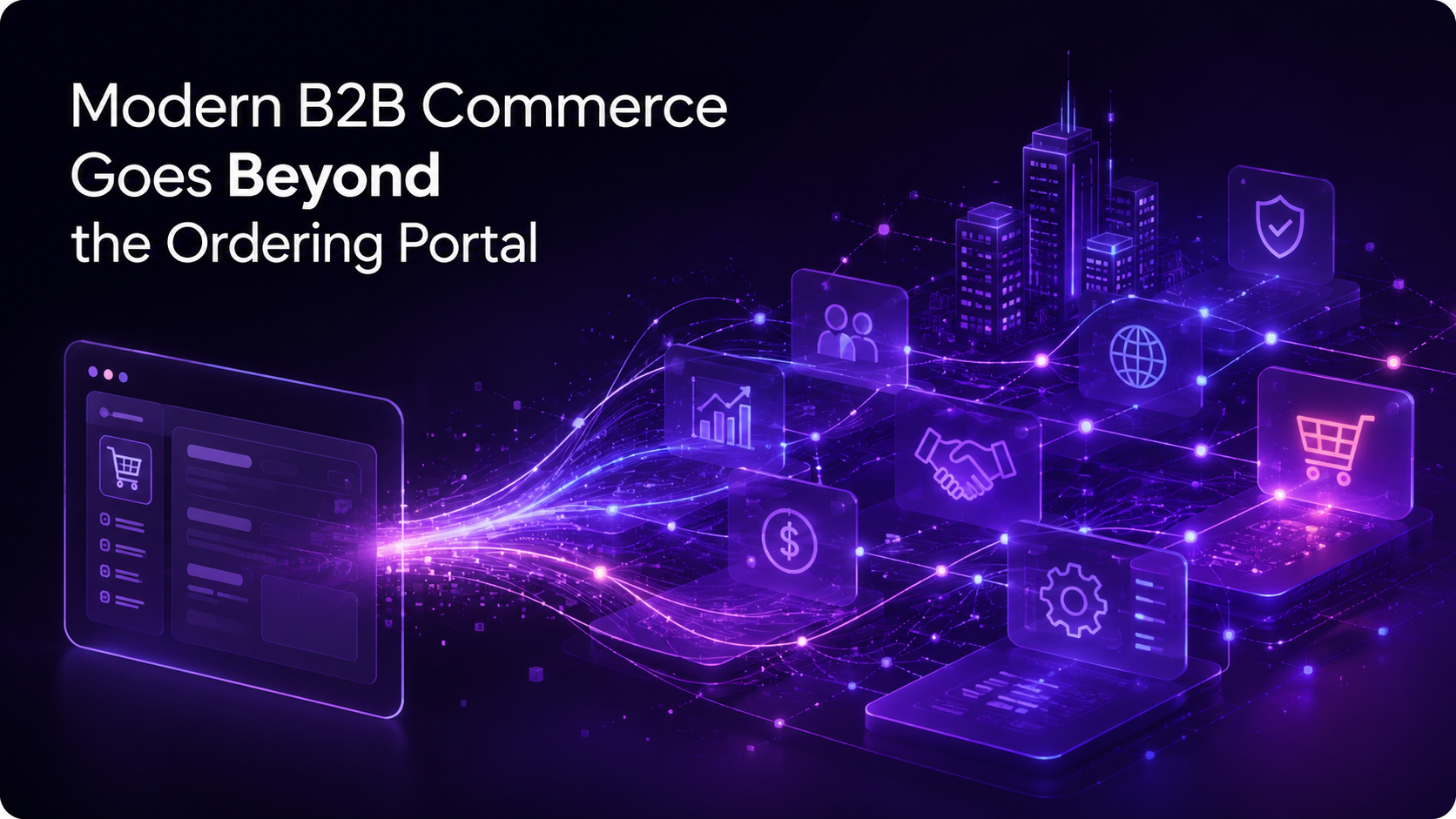
This is why modern B2B commerce goes beyond the ordering portal.
It is no longer just about digitising the transaction. It is about digitising the commercial relationship behind the transaction.
Business buyers increasingly expect digital experiences that are faster, clearer and easier to navigate. At the same time, internal teams are under pressure to improve efficiency, serve customers better and work with increasingly complex product, pricing and channel structures.
As a result, the B2B agenda has become more ambitious.
Organisations are now asking questions such as:
These are not ordering-portal questions. They are broader commerce questions.
And they reflect a shift in how B2B leaders think about digital transformation.
One of the reasons traditional B2B portals often fall short is that B2B commerce is rarely as simple as a catalogue and a basket.
In most B2B environments, each customer relationship has its own structure. Different customers may have different product access, different pricing models, different payment terms and different delivery expectations. A single customer organisation may also include multiple branches, users, buyers and approval authorities.
That means a modern B2B platform must do more than recognise a login.
It needs to reflect the commercial reality of the account behind that user.
This includes the ability to support customer-specific catalogues, account structures, pricing logic, purchasing permissions and workflows that mirror how businesses actually buy and sell.
When these structures are not represented digitally, the process quickly falls back into manual work: emails for price checks, calls for stock confirmation, offline approval loops and repeated support requests for routine transactions.
The more accurately a platform can represent these relationships, the more useful and scalable the digital channel becomes.
Another limitation of traditional B2B portals is that they focus too narrowly on the act of placing an order.
In reality, the B2B journey is much wider.
Before ordering, buyers may need to discover the right products, review technical information, compare options, understand the prices and terms available to them, and complete internal approval processes.
After ordering, they often need visibility into fulfilment, delivery, order history, repeat purchasing and customer service processes.
If customers still need to contact someone to complete those steps, then the experience is only partially digital.
Modern B2B commerce therefore needs to support more than ordering. It needs to support a connected customer journey.
This is where the value of a modern platform becomes clear: not by simply moving orders online, but by making the wider buying experience more transparent, manageable and efficient for both sides of the relationship.
Modern B2B commerce also depends on what happens behind the screen.
The customer-facing experience is only one part of the picture. In practice, B2B sales depend on multiple systems working together: product information, customer data, commercial rules, pricing, stock, order processes and operational workflows.
This is why modern B2B commerce cannot operate as an isolated portal.
It needs to connect with the systems that already run the business, whether that means ERP, CRM, PIM, fulfilment or other operational environments.
For many organisations, the goal is not to replace existing systems overnight. The goal is to create a more connected and flexible commerce layer that can work with those systems and improve the digital sales experience step by step.
That broader integration mindset is now a central part of the B2B modernisation agenda.
At Lidia Commerce, B2B is approached from this wider perspective.
Rather than treating B2B as a standalone ordering screen, Lidia helps organisations build modern digital commerce experiences around the way B2B relationships actually work.
This means supporting the structures behind the transaction: customer-specific commercial conditions, account-based experiences, operational processes and integration with the wider enterprise landscape.
As a modular digital commerce platform, Lidia enables organisations to shape B2B experiences that are better aligned with their business model and customer relationships. Instead of forcing a one-size-fits-all structure, the platform can work alongside existing systems and support a more connected approach to digital sales.
This is particularly important for organisations that want to modernise in a controlled and incremental way.
Many enterprises already have core systems in place. What they need is not another disconnected portal, but a B2B commerce layer that can help unify customer experience, business rules and operational processes in a more flexible way.
That is where Lidia creates value.
The direction of B2B commerce is clear.
The organisations creating value in this space are not simply digitising order entry. They are creating connected digital environments where customers can interact with the business more efficiently, where internal teams can reduce repetitive manual work, and where commercial complexity can be managed more effectively.
In that sense, the ordering portal is no longer the destination.
It is only one part of a much broader commerce capability.
Modern B2B commerce is about connecting the customer experience with the commercial and operational reality of the business.
And that is exactly why the conversation has moved beyond the ordering portal.
Lidia Commerce is a modular digital commerce platform supporting B2B, B2C and marketplace business models. It helps organisations build and evolve commerce capabilities while integrating with existing business systems and operational environments.


