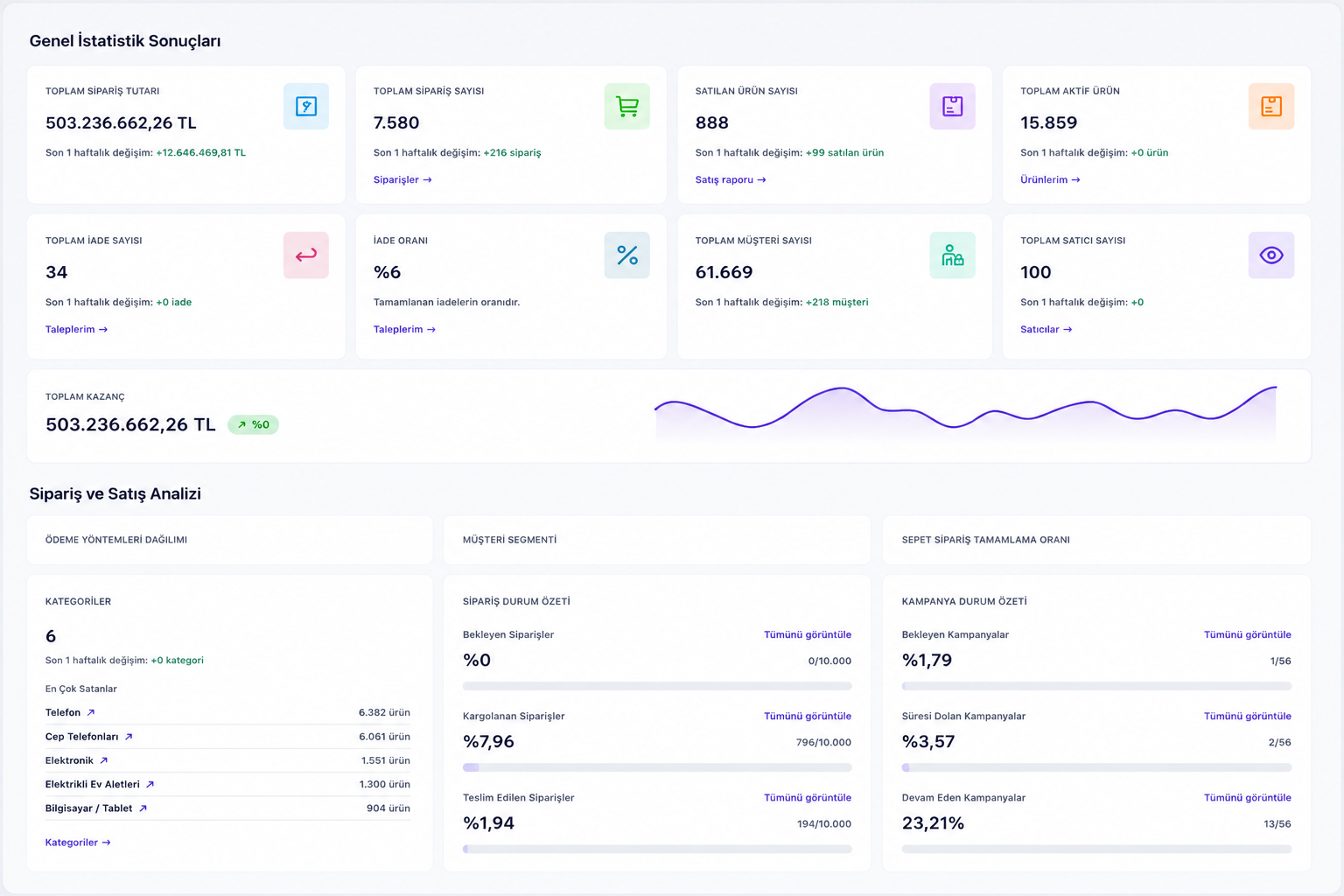
Lidia Console is the centralized administration interface of the Lidia Commerce Platform, designed to manage digital commerce operations from a single workspace.
It enables business and operations teams to manage operational processes such as user management, order processing, inventory tracking, campaigns, reporting, and system configurations through a unified platform.
Lidia Console can be used across various commerce models, including B2B, B2C, B2E, B2F, and Marketplace. Available modules, screens, and capabilities may vary depending on the selected Lidia solution, enabled modules, organizational configuration, and user permissions.
Feature Availability
The features described on this page represent the general capabilities
of Lidia Console. Available modules and actions may vary depending on
the selected solution and the permissions assigned to each user.
Core Management Areas
Lidia Console provides centralized management tools that support day-to-day business and operational processes.
User and Permission Management
Manage users and access rights securely across the platform.
Available capabilities may include:
Creating and managing users
Defining roles
Assigning permissions
Module-based access control
Organization-based authorization
Order Management
Monitor and manage the entire order lifecycle from a centralized interface.
Available capabilities may include:
Viewing orders
Reviewing order details
Updating order statuses
Managing cancellations
Managing returns
Tracking refund processes
Monitoring payment statuses
Inventory Management
Monitor and manage product availability across the organization.
Available capabilities may include:
Viewing current inventory levels
Updating inventory quantities
Managing inventory across multiple locations
Performing bulk inventory operations
Tracking inventory movements
Monitoring low-stock products
Customer and Organization Management
Manage customer, merchant, dealer, organization, or employee records depending on the active commerce solution.
Available capabilities may include:
Viewing profile information
Managing contact information
Accessing organization records
Reviewing transaction history
Managing organization settings
Campaign and Promotion Management
Create and manage campaigns that support sales and marketing activities.
Available capabilities may include:
Creating campaigns
Defining promotion rules
Managing coupon codes
Scheduling campaigns
Monitoring campaign performance
Analytics and Reporting
Monitor operational and business performance through dashboards and reporting tools.
Available reports may include:
Sales reports
Order reports
Revenue analysis
Inventory reports
Customer analytics
Operational performance reports
Financial summaries
Advanced Management Capabilities
In addition to day-to-day operational management, Lidia Console may provide advanced tools for managing products, content, and business data.
The capabilities described in this section may vary depending on the selected Lidia solution, enabled modules, and organizational configuration.
Catalog and Product Management
Manage product information centrally and prepare product data for
multiple sales channels.
Available capabilities may include:
Creating and updating products
Managing categories
Managing product relationships
Managing product variants
Managing pricing and tax information
Managing media and documents
Performing bulk product operations
Synchronizing products with Lidia PIM or external systems
Content Management System (CMS)
The Content Management System enables business users to manage digital
content without requiring technical development.
Available capabilities may include:
Managing banners
Creating and updating content pages
Managing campaign content
Scheduling content publication
Managing multilingual content
Editing rich text content
Managing images and other media assets
Search, Filtering, and List Management
List screens throughout Lidia Console provide common tools that help
users efficiently manage large volumes of data.
Available capabilities may include:
Keyword search
Advanced filtering
Column sorting
Pagination
Bulk record selection
Bulk update operations
Data export options
Customizable list views
Dashboard and Operational Monitoring
The Dashboard provides a centralized view of operational activities and key business metrics.
Dashboard and Operational Monitoring
The Dashboard provides a centralized view of key commerce metrics,
operational activities, and performance data. It helps users monitor
current results, identify changes, and access records that require
attention.
Depending on the active solution, the Dashboard may display:
Total order value and order volume
Sold and active product counts
Return volume and return rate
Customer and merchant totals
Category and product performance
Order and campaign status summaries
Weekly changes and operational performance indicators
Top-selling and most-returned products
Displayed metrics and dashboard sections may vary depending on the
selected solution, enabled modules, and the user's permissions.
Integration Capabilities
Lidia Console is designed to work with Lidia Commerce components and external enterprise systems. Integration capabilities can be grouped according to the business process they support.
Product and Catalog Integrations
Lidia Console integrates with Lidia PIM, Connectors, and external
systems to securely synchronize product, variant, category, pricing,
and inventory data.
ERP and CRM Connections
ERP and CRM integrations enable the synchronization of customer,
organization, order, inventory, and commercial data across enterprise
systems.
Payment Integrations
Payment integrations support payment processing, virtual POS
connections, payment status synchronization, refunds, and cancellation
workflows.
Logistics and Fulfillment Integrations
Logistics and fulfillment integrations connect Lidia Console with
shipping providers, warehouse systems, and delivery services to
support end-to-end fulfillment operations.
Accounting and Finance Integrations
Accounting and finance integrations enable invoices, financial
transactions, commissions, settlements, and reporting data to be
shared with enterprise finance systems.
API and External System Integrations
Lidia APIs enable seamless integration with external commerce
platforms, enterprise applications, custom business systems, and
third-party services.
Note:
Available integrations may vary depending on the organization's technical
infrastructure, business requirements, and enabled Lidia components.