Lidia Commerce has a modular architecture aligned with MACH principles, enabling businesses to build their digital commerce infrastructure according to their specific needs.
MACH represents the following four core principles:
Microservices-based: Business capabilities are delivered through independent microservices.
API-first: Communication between services and applications is handled through APIs.
Cloud-native: The platform is designed to operate and scale efficiently in cloud environments.
Headless: The user interface is separated from the underlying commerce services.
This approach allows Lidia Commerce to provide a flexible digital commerce infrastructure in which different components can be combined as needed, rather than relying on a rigid monolithic system.
What Is Headless Commerce?
Headless commerce is an architectural approach in which customer-facing web and mobile interfaces operate independently from the backend services that manage commerce processes.
This structure allows businesses to design different user experiences without replacing their commerce infrastructure and to use the same services across websites, mobile applications, B2B portals, marketplaces, and other sales channels. Product, inventory, order, and customer processes do not need to be rebuilt whenever a new channel is launched.
What Does API-First Mean?
API-first means that the platform’s business capabilities are designed to be accessible primarily through APIs.
Lidia Commerce uses APIs to enable communication between services, management applications, and external systems. This allows web and mobile applications, ERP and CRM systems, payment platforms, logistics services, and other third-party solutions to integrate with Lidia in a standardized and controlled manner.
What Is a Microservices Architecture?
A microservices architecture divides the digital commerce infrastructure into independent services, each responsible for a specific business domain.
Processes such as orders, inventory, delivery, identity, content, and notifications can be managed by separate services. These services can be developed, updated, and scaled independently, reducing the risk that a change in one area will affect the entire platform.
What Is Cloud-Native Architecture?
Cloud-native architecture refers to applications designed to take advantage of the flexibility, automation, and scalability provided by cloud environments.
Lidia Commerce’s service-based structure enables individual components to scale independently according to transaction volume. The platform can be deployed in cloud or on-premises environments based on the organization’s infrastructure and security requirements.
What Is Composable Commerce?
Composable commerce enables businesses to build their digital commerce infrastructure by selecting the products, services, and applications they need.
Thanks to Lidia Commerce’s modular structure, businesses can adopt only the required capabilities without replacing their entire existing infrastructure. For example, product information can be managed through Lidia PIM while the existing ERP system remains in use, and Commerce Engine services can support order and inventory processes.
This approach enables new capabilities to be introduced gradually and allows the platform to evolve as business requirements change.
Core Architectural Approach
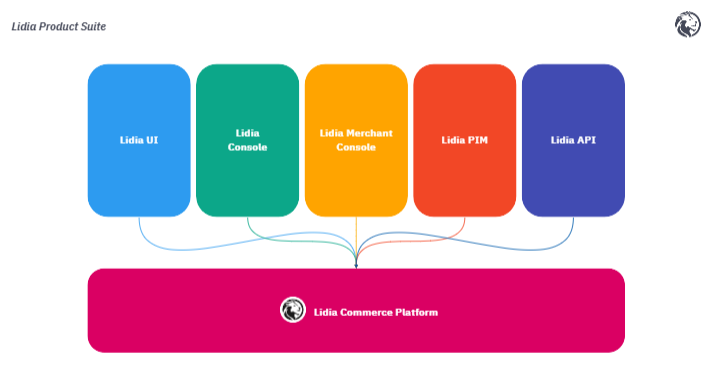
The Lidia Product Suite is built around the Lidia Commerce Platform, which provides the shared digital commerce capabilities used across Lidia products and applications.
Lidia UI, management consoles, Lidia PIM, and Lidia API connect to the same platform while serving different users and business needs. This structure enables customer experiences, operational management, product information, commerce services, and integrations to work together within a unified architecture.
Lidia UI — Experience Layer
Lidia UI, also referred to as LUI, is the customer-facing experience layer of the Lidia Product Suite.
It provides the user interfaces through which customers, business users, employees, dealers, or other target audiences interact with digital commerce experiences. Depending on the business model, LUI can support websites, mobile applications, B2B portals, employee portals, field applications, and marketplace storefronts.
Thanks to Lidia Commerce's headless architecture, these interfaces can be developed and customized independently while continuing to use the same underlying commerce services.
Management Applications
Management applications provide the operational interfaces used to configure, manage, and monitor digital commerce processes.
Lidia Console, used by administrators and operational teams to manage platform-wide commerce processes.
Merchant Console, used by merchants and sellers to manage their own products, orders, and related operations.
Network Console, used by field employees, dealers, or authorized network users to access role-specific operational capabilities.
The navigation structure, available features, and permitted actions may vary according to the business model, organizational structure, platform configuration, and user permissions.
Digital Commerce Services
Digital Commerce Services form the operational foundation of the Lidia Commerce Platform. Lidia Commerce Engine consists of independent microservices responsible for different digital commerce domains, including catalog, inventory, orders, payments, delivery, identity, organizations, content, documents, notifications, campaigns, and search. These services can be used by Lidia UI, management applications, Lidia PIM, and external systems through APIs. Their independent structure allows different capabilities to be developed, updated, and scaled without requiring the entire platform to be changed.
Catalog & Inventory Management
Supports centralized management of products, categories, brands,
variants, pricing, warehouses, SKUs, and inventory. It includes
the Metadata and
Inventory services.
Cart & Order Management
Manages the order lifecycle from cart and checkout to orders,
invoices, refunds, and transaction records. These processes are
supported by the Order service.
Payment & Delivery Management
Combines payment, collection, wallet, and refund processes with
delivery and logistics operations. It includes the
Collector and
Delivery services.
Promotion & Coupon Management
Supports the management of coupons, promotions, audiences,
campaign conditions, and rewards. These capabilities are provided
through the Marketing service.
Identity & Access Management
Supports the management of users, roles, permissions, consents,
and segments. This module includes the
Identity service.
Organizational Hierarchies
Supports the management of organizations, applications, branches,
contracts, and commercial conditions. These processes are handled
by the Organization service.
Content Management
Manages pages, menus, content models, blocks, lists, localization,
and media. This module includes the
Content service.
Document Management
Supports storing documents in folders and vaults, querying them,
and managing their lifecycle. These capabilities are provided
through the Document service.
Case Management
Supports the management of user requests and case processes
together with related posts, stakeholders, and attachments. This
module includes the Case service.
Social Features & Notifications
Supports topics, comments, user interactions, notifications, and
subscription processes. It includes the
Social and
Notification services.
Search & Reporting
Supports indexing, searching, and reporting across different data
types. These capabilities are provided through the
Search service.
Lidia PIM — Product Information Management
Lidia PIM is the product information management layer of the Lidia Product Suite.
It enables product, variant, category, brand, attribute, option, media, and document information to be created, enriched, governed, and managed centrally.
Product information prepared in Lidia PIM can be structured according to the requirements of different sales channels and transferred to Lidia Commerce applications or external systems through feeds and APIs.
By separating product information management from channel-specific interfaces, businesses can maintain a consistent and reusable source of product data across their digital commerce ecosystem.
Lidia API — Integration Layer
Lidia API provides standardized access to the capabilities and data available within the Lidia Commerce Platform.
It enables Lidia products, custom applications, and third-party systems to communicate with the platform through controlled and documented APIs.
ERP, CRM, payment, logistics, accounting, reporting, and other external systems can integrate with Lidia Commerce through this layer. Lidia API also allows businesses to build custom web, mobile, or enterprise applications without directly coupling them to the platform's internal services.
This approach enables organizations to preserve their existing technology investments while extending their ecosystem with Lidia Commerce capabilities.
How the Components Work Together
Lidia UI delivers digital experiences to end users. Management applications allow operational teams, merchants, and network users to manage commerce processes. Lidia PIM provides centrally governed product information. Lidia API connects the platform with external and custom applications.
All these components use the shared capabilities provided by the Lidia Commerce Platform and its Digital Commerce Services.