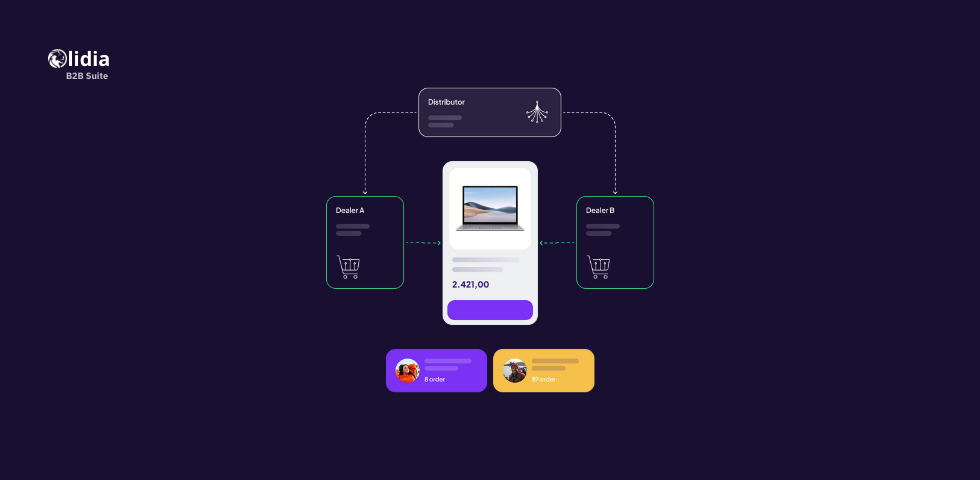
Lidia B2B Suite is a comprehensive B2B commerce and order management solution that enables businesses to centrally manage digital commerce processes with dealers, distributors, partners, and corporate customers.
Designed to support the customer- and partner-specific catalogs, pricing, discounts, payment terms, and ordering processes required by B2B commerce, Lidia B2B Suite helps businesses digitize commercial relationships, reduce operational workload, and efficiently manage growing partner networks.
From product and service catalogs to order and payment processes, and from partner management to logistics operations, different commercial processes can be managed within a unified structure. Its API-first and microservice-based architecture enables seamless integration with ERP, CRM, and other enterprise systems while providing a flexible and scalable digital commerce infrastructure.
Digitize B2B Commerce Processes
Lidia B2B Suite transforms traditional dealer and corporate sales processes into a digital commerce experience.
Businesses can define partner-specific products, catalogs, prices, discounts, and payment terms, centrally manage orders, and create commercial models tailored to different customer groups.
This structure reduces manual operations while making everyday activities such as placing orders, tracking orders, and reordering faster and easier to manage.
Partner Management
Dealers, distributors, and other business partners can be managed
through a centralized structure.
The onboarding of new partners can be digitized and simplified,
while different commercial rules and operating conditions can be
defined for each partner.
Businesses can:
- Create partner-specific catalogs and product access,
- Define different price lists and discount conditions,
- Manage payment methods and commercial terms by customer,
-
Maintain partner relationships through a centralized and
controlled structure.
This enables growing dealer and partner networks to be managed more
efficiently and at scale.
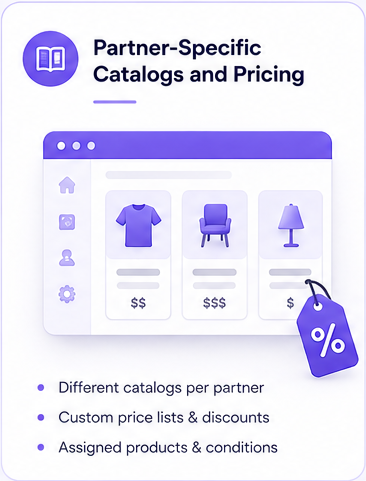
Partner-Specific Catalogs and Pricing
In B2B commerce, every customer or dealer does not need to operate
with the same products, prices, or commercial terms.
With Lidia B2B Suite, different:
- Product catalogs,
- Price lists,
- Discounts,
- Promotion rules,
- Payment methods,
- Commercial terms
can be defined for individual dealers or customer groups.
Users therefore see and order only the products and commercial
conditions assigned to them.
Flexible Pricing and Promotion Management
Lidia B2B Suite supports the flexible pricing models required by B2B
commerce.
Different prices and discount structures can be configured according
to the customer, dealer, or commercial agreement. Volume-based
discounts, bundle offers, time-sensitive campaigns, and similar
promotion models can also be applied to B2B transactions.
This allows businesses to manage both standard price lists and
customer-specific commercial conditions through the same digital
commerce infrastructure.
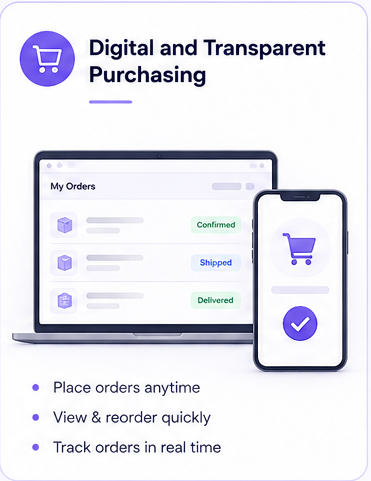
Digital and Transparent Purchasing
Dealers and corporate customers can view the products and prices
assigned to them and place their orders digitally.
Users can:
- Create new orders at any time,
- View their previous orders,
- Quickly reorder based on previous purchases,
- Place orders on behalf of different stores or warehouses,
- Track their orders throughout the process.
This reduces manual workload in repetitive corporate purchasing
processes and creates a faster and more transparent purchasing
experience.
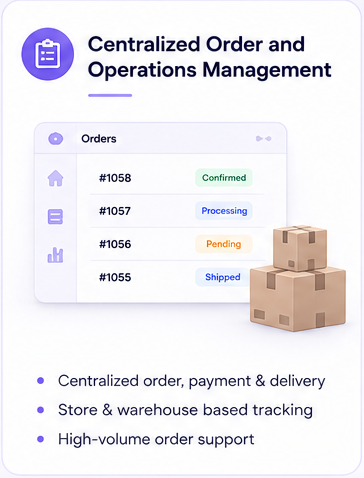
Centralized Order and Operations Management
Order, payment, delivery, and operational processes can be managed
through a centralized structure.
The infrastructure supports high-volume B2B ordering scenarios,
enabling businesses to continue operating efficiently as transaction
volumes increase.
The ability to track orders in the context of stores, warehouses, or
corporate customers also helps operational teams manage order
processes with greater control and visibility.
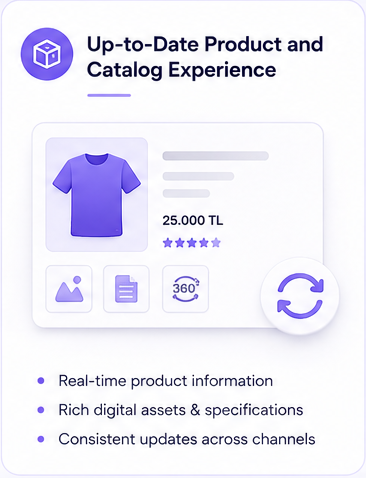
Up-to-Date Product and Catalog Experience
Business partners can centrally access the product catalogs and
related digital content assigned to them.
Product information, prices, inventory data, images, technical
specifications, and other digital assets can be presented with
up-to-date information, helping partners make purchasing decisions
based on accurate data.
Centralized data management also enables product and commercial
updates to be consistently reflected across relevant B2B sales
channels.
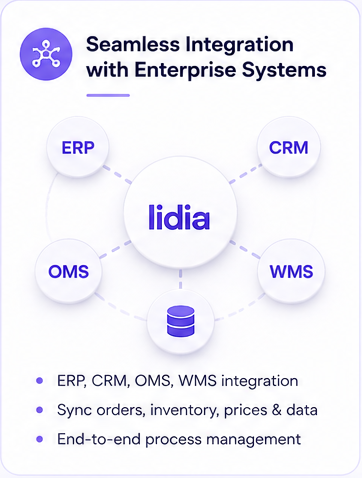
Seamless Integration with Enterprise Systems
Lidia B2B Suite is designed to integrate with existing enterprise
systems.
Through integrations with ERP and other business systems:
- Order data,
- Product and catalog information,
- Pricing,
- Inventory information,
- Customer and dealer data,
- Payment and logistics processes
can be synchronized across systems.
This helps maintain data consistency throughout the B2B commerce
lifecycle, from ordering to delivery, while reducing the need for
manual data transfers between systems.
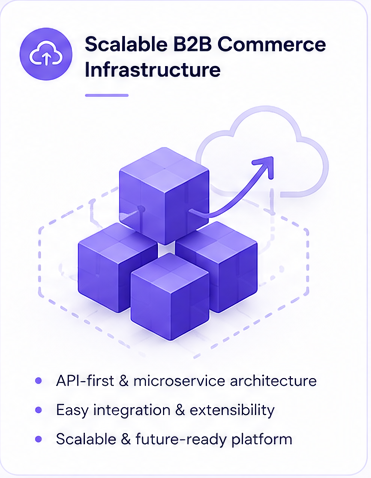
Scalable B2B Commerce Infrastructure
The API-first and microservice-based architecture
of Lidia B2B Suite allows businesses to integrate the platform with
their existing technology ecosystem and adapt it to changing
commercial requirements.
Whether onboarding new partners, introducing different catalog and
pricing models, or managing increasing order volumes, the platform
supports the controlled and sustainable growth of B2B operations.
Lidia B2B Suite brings together partner management,
pricing, ordering, payments, and logistics processes within a single
digital commerce infrastructure, enabling businesses to build a
faster, more efficient, and scalable B2B commerce model.