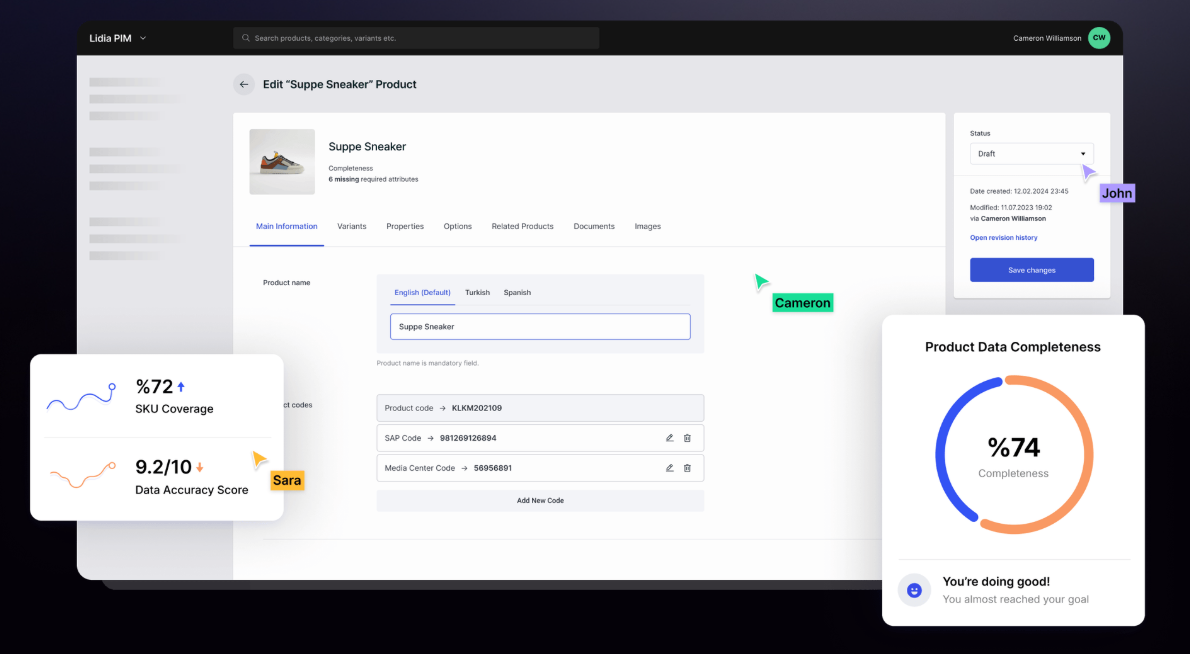
Lidia PIM (Product Information Management) is a centralized product information management solution that enables organizations to collect, structure, enrich, and distribute product information from a single platform across multiple systems and sales channels.
In modern commerce ecosystems, product information originates from many different sources, including ERP systems, suppliers, manufacturers, e-commerce platforms, marketplaces, and other business applications. Lidia PIM consolidates this information into a centralized platform, ensuring data consistency, accuracy, and reliability throughout the entire product lifecycle. This allows organizations to manage product information more efficiently, streamline operational processes, and deliver consistent product experiences across every sales channel.
>
```
```
Lidia PIM supports the product information management process through three core stages:
1. Product Data Acquisition
Collect product information from multiple sources and organize
it within a standardized data model.
Organizations can define product families, data schemas,
categories, brands, variant structures, and other
catalog components to build a centralized product data
foundation. Product information can be imported into Lidia PIM
from ERP systems, suppliers, manufacturers, e-commerce
platforms, and other business applications through
Excel imports, APIs, and enterprise integrations.
2. Product Data Enrichment
Transform raw product information into
complete, accurate, and channel-ready product
content.
Product descriptions, technical specifications, images,
videos, digital assets, documents, related products,
and other supporting content can all be managed centrally.
Product content can also be localized with
multilingual information, regional values, and
channel-specific content requirements.
Validation rules, approval workflows, and data quality
controls help identify incomplete or inaccurate
information, ensuring that only approved and reliable product
data is published.
3. Product Data Distribution
Distribute approved product information consistently from a
single source to multiple systems and sales
channels.
Lidia PIM simplifies product data sharing through
APIs, feed structures, import/export processes, and
enterprise integrations, enabling seamless
communication with e-commerce websites, marketplaces,
mobile applications, ERP systems, and other business
platforms. This ensures that every connected channel always
receives the latest approved product information. This centralized
approach helps organizations reduce time to market,
maintain product data consistency across regions and channels,
and scale product operations as catalog volumes grow.
Core Lidia PIM Capabilities
While the three core stages define the product information lifecycle, Lidia PIM also provides a comprehensive set of platform capabilities that enable organizations to manage product information efficiently at scale.
These capabilities support every stage of the lifecycle—from collecting and structuring product data to enriching, governing, and distributing information across multiple systems and sales channels.
Centralized Product Information Management
Manage product information, digital assets, attributes, and catalog
structures from a centralized source of truth, helping maintain
consistent and reliable data across connected systems and channels.
Flexible Product Data Modeling
Build flexible product structures using no-code data schemas, product
families, attributes, options, categories, brands, and variant
models. Business teams can adapt product structures without depending
on development teams for every change.
Product Data Enrichment
Enhance product content with attributes, specifications, images,
videos, documents, multilingual information, and channel-specific
values. Guided tools, Excel operations, and bulk updates help
business teams enrich large product catalogs efficiently.
Product Data Quality & Governance
Maintain reliable product information through validation rules,
mandatory fields, approval processes, data locks, enrichment logic,
and consistency checks. These controls help identify incomplete
records and ensure that only approved, channel-ready product data is
published.
Digital Asset Management
Manage images, videos, documents, and other digital assets from a
centralized media structure. Assets can be organized, reused, and
associated with products and variants across the catalog.
Smart Search & Filtering
Quickly locate and manage products, variants, categories, media, and
other catalog records using search, filters, facets, and tagging
structures. This helps teams work efficiently across large and
complex product data sets.
Multi-Channel Product Distribution
Prepare and distribute approved product information to websites,
marketplaces, mobile applications, printed materials, and third-party
systems. Channel-specific mappings and feed configurations allow
centralized product data to be adapted to different destination
requirements through scheduled or integration-based synchronization.
Import, Export & Feed Management
Exchange product data through Excel imports, exports, APIs, feed
structures, and bulk operations. These capabilities support efficient
product onboarding, large-scale updates, and controlled data sharing
with external systems.
Enterprise Integration
Integrate Lidia PIM with ERP, CRM, Commerce platforms, marketplaces,
suppliers, content systems, and other enterprise applications through
APIs and integration services. The platform supports automated and,
where applicable, bi-directional synchronization to reduce manual
effort and data discrepancies.
Collaboration, Roles & Workflow Management
Enable multiple teams to work securely on product information through
role-based permissions, approval processes, responsibility
management, edit tracking, and change history. This supports clear
ownership and controlled collaboration across product, content,
marketing, and operational teams.
Analytics & Catalog Insights
Monitor product data completeness, enrichment progress, catalog
quality, publishing readiness, and operational activity through
available dashboards and reports. These insights help teams identify
incomplete records and prioritize catalog improvements.
Scalable Product Information Platform
Support growing product catalogs, increasing data volumes, multiple
business units, and expanding operational requirements through a
scalable and flexible product information management foundation.
Get Started with Lidia PIM
Lidia PIM is also available as a free edition for organizations that
want to explore the platform and experience its core product
information management capabilities.
You can request free access to Lidia PIM and start creating,
enriching, and managing your product catalog in minutes.