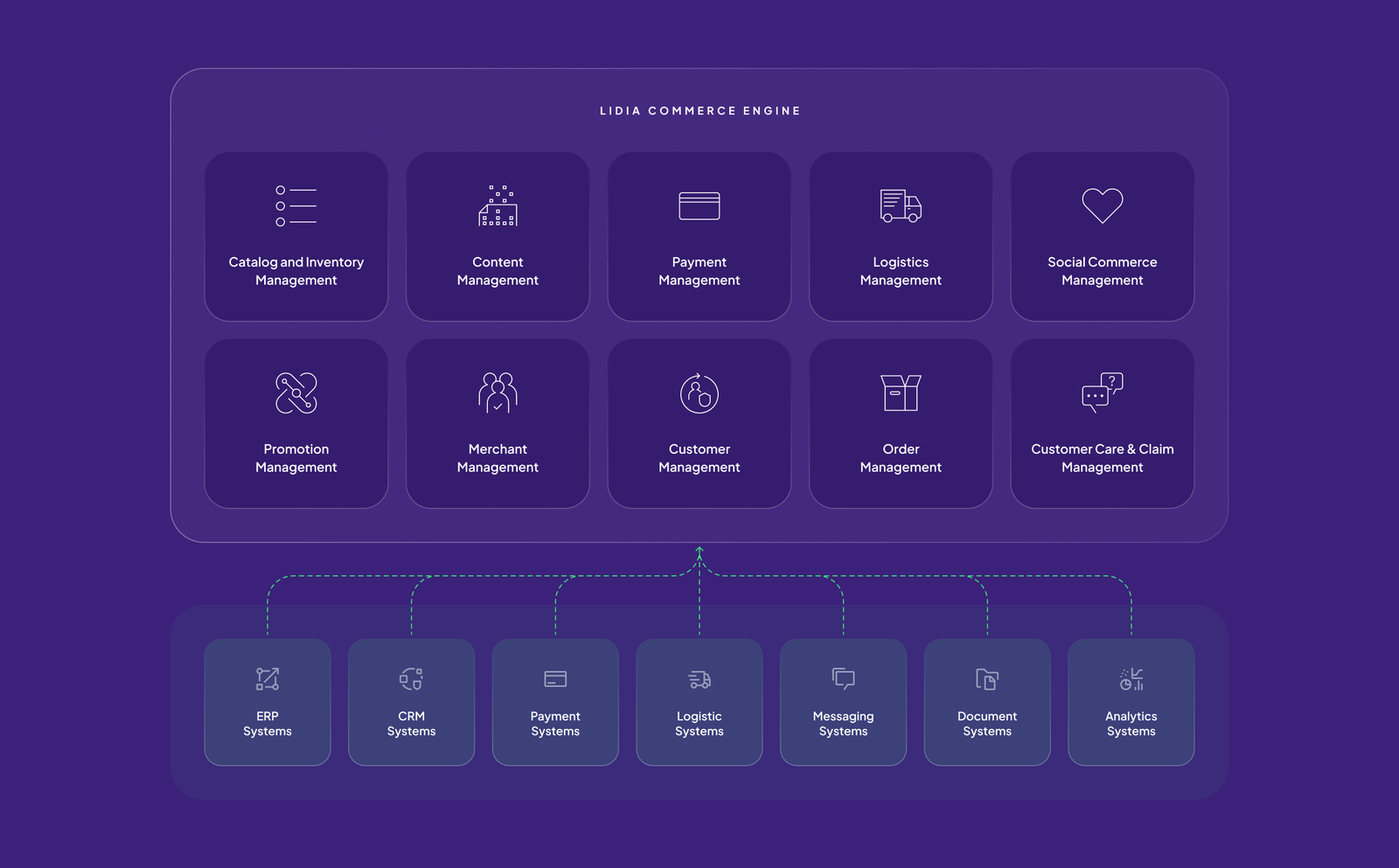
Lidia Core is the core component of the Lidia Commerce Platform,
providing the centralized commerce engine that powers digital commerce
operations behind the scenes.
Designed for mid-sized and enterprise organizations, Lidia Core enables
businesses to manage essential commerce processes—including orders,
inventory, customers, deliveries, content, campaigns, and other
operational workflows—through a flexible, scalable, and reliable
backend infrastructure.
Delivered as a Backend as a Service (BaaS) solution, Lidia Core allows
organizations to leverage ready-to-use commerce capabilities instead of
building core commerce infrastructure from scratch. This enables
development teams to focus on customer experience, operational
efficiency, and digital innovation rather than foundational backend
development.
Built on a headless, API-first, and microservice-based architecture,
Lidia Core adapts easily to different business requirements, technology
stacks, and digital channels.
A Modern, Modular, and Centralized Commerce Infrastructure
Lidia Core separates customer-facing applications from backend commerce operations. Websites, mobile applications, customer portals, partner portals, kiosks, and other digital touchpoints can all integrate with the same backend services while remaining completely independent in terms of user experience and technology.
Rather than enforcing a predefined application structure or business model, Lidia Core provides modular commerce services that can be selected, combined, and customized according to each organization's requirements.
Services such as order management, inventory, customer management, delivery, content, campaigns, and notifications can be integrated individually or together, depending on the needs of the solution.
With this approach, organizations can:
Use only the services they need.
Build unique digital experiences across different channels.
Extend existing systems without replacing them.
Manage commerce data and operations through a centralized backend.
Expand their solution over time as business requirements evolve.
Instead of delivering a one-size-fits-all commerce application, Lidia Core provides the building blocks required to create customized commerce solutions tailored to each organization's needs.
Modern Architecture
Lidia Core is built on three fundamental architectural principles that support modern digital commerce.
Headless Architecture
The customer-facing experience is completely decoupled from backend
commerce operations.
Organizations can build websites, mobile applications, or any other
digital experience using their preferred technologies while relying
on Lidia Core to manage business-critical processes such as orders,
inventory, customers, and deliveries.
This separation allows frontend applications to evolve independently
without affecting the underlying commerce infrastructure.
API-First Approach
Every capability provided by Lidia Core is accessible through
well-defined APIs.
This enables seamless integration with ERP, CRM, PIM, payment
providers, logistics systems, accounting software, and other
enterprise or third-party applications.
Organizations can preserve their existing technology investments
while extending their ecosystem with Lidia Core services.
Microservice-Based Architecture
Lidia Core consists of independent microservices, each responsible
for a specific business domain.
Services such as order management, inventory, identity, content,
marketing, delivery, and notifications can be developed, deployed,
updated, and scaled independently.
This modular architecture improves maintainability, scalability, and
flexibility while allowing organizations to utilize only the services
required for their solutions.
Discover Lidia Core
To explore the services, API structures, and technical operations
supported by Lidia Core in greater detail, visit the Lidia Developer
Portal.
The Developer Portal provides detailed information about service use
cases, endpoints, request and response structures, authentication
requirements, and technical implementation details.
Lidia Core enables organizations to build digital commerce solutions faster by providing modular, production-ready commerce services.
Faster Development
Reduces the need to develop fundamental commerce capabilities from
scratch, allowing teams to focus on business value and customer
experience.
Flexible Customization
Services can be selected and configured according to specific
operational requirements instead of forcing organizations into
predefined application structures.
Easy Integration
The API-first architecture simplifies integration with enterprise
systems and third-party platforms.
Independent Scalability
The microservice architecture allows individual services to scale
independently based on workload and business demand.
Centralized Commerce Operations
Multiple applications and digital channels can share the same backend
services, ensuring consistent data and unified business processes.
Long-Term Extensibility
Organizations can continuously expand their solutions by adding new
services and integrations as business requirements evolve.
Flexible Deployment Options
Lidia Core can be deployed in different environments to align with an organization's infrastructure strategy, security policies, and operational requirements.
Cloud Deployment
Lidia Core supports deployment on leading cloud platforms such as
Amazon Web Services (AWS), Microsoft Azure, and Huawei Cloud.
Cloud deployment enables organizations to scale resources efficiently,
reduce infrastructure management efforts, and benefit from high
availability and disaster recovery capabilities.
On-Premises Deployment
Organizations that require full control over their infrastructure and
data can deploy Lidia Core within their own environment.
This option is ideal for businesses with strict security policies,
regulatory requirements, or existing on-premises infrastructure.
Infrastructure Flexibility
Lidia Core can run on both Kubernetes and Virtual Machine (VM)
environments, whether deployed in the cloud or on-premises.
This flexibility allows organizations to choose the infrastructure
model that best aligns with their operational and technical
requirements.
Who Is It For?
Lidia Core is designed for medium and large enterprises looking to leverage flexible, scalable commerce services to support their digital transformation initiatives.
Implementing Lidia Core does not require building a complete B2C, B2B, B2E, B2F, or Marketplace platform.
Instead, organizations can integrate only the services they need into their existing ecosystem or use them as the foundation for entirely custom digital solutions.
E-commerce
E-commerce businesses require flexible and scalable solutions to manage
high-volume transactions and complex product catalogs. The Lidia
Commerce Engine's headless architecture allows for seamless integration
with various front-end platforms. Microservices like Lidia Search for
advanced product search and Lidia Marketing for targeted campaigns
enhance the overall shopping experience and operational efficiency.
IT
IT companies looking to extend their solutions with digital commerce
capabilities. The Lidia Commerce Engine provides the necessary
infrastructure and flexibility to integrate digital commerce into their
existing technology solutions.
Retail
Encompasses brick-and-mortar and online retailers aiming to expand,
optimize or centralize operations. The engine provides tools for
managing product catalogs, customer data, and order fulfillment.
Healthcare
The healthcare sector requires robust data management and secure
transactions. The Lidia Commerce Engine's Case management for managing
patient cases and Document management capabilities for handling medical
records ensure compliance and security. Additionally, the platform's
scalability supports the high volume of transactions and data exchanges
typical in healthcare operations.
Manufacturing
Facilitates direct-to-consumer sales and efficient supply chain
management. Manufacturers can leverage the engine to integrate with ERP
systems and manage complex product data.
FMCG
Businesses in the FMCG sector seeking to create alternative
distribution channels, manage product data, and enhance their digital
presence. The Lidia Commerce Engine provides tools to manage high-volume
transactions and streamline operations.
Education
Educational institutions and suppliers can create marketplaces for
educational materials and resources using the Lidia Commerce Engine.
Lidia Content manages digital assets, and Lidia Subscription supports
course subscriptions and memberships. The platform's scalability
ensures it can handle high traffic during enrollment periods or online
classes.
Automotive
Automotive companies need efficient parts, accessories, and service
management. The Lidia Commerce Engine's Inventory and Order Management
capabilities help manage complex product configurations and streamline
order processing. Our Delivery capabilities ensures timely parts
delivery, which is crucial for maintaining customer satisfaction in
after-sales services.